
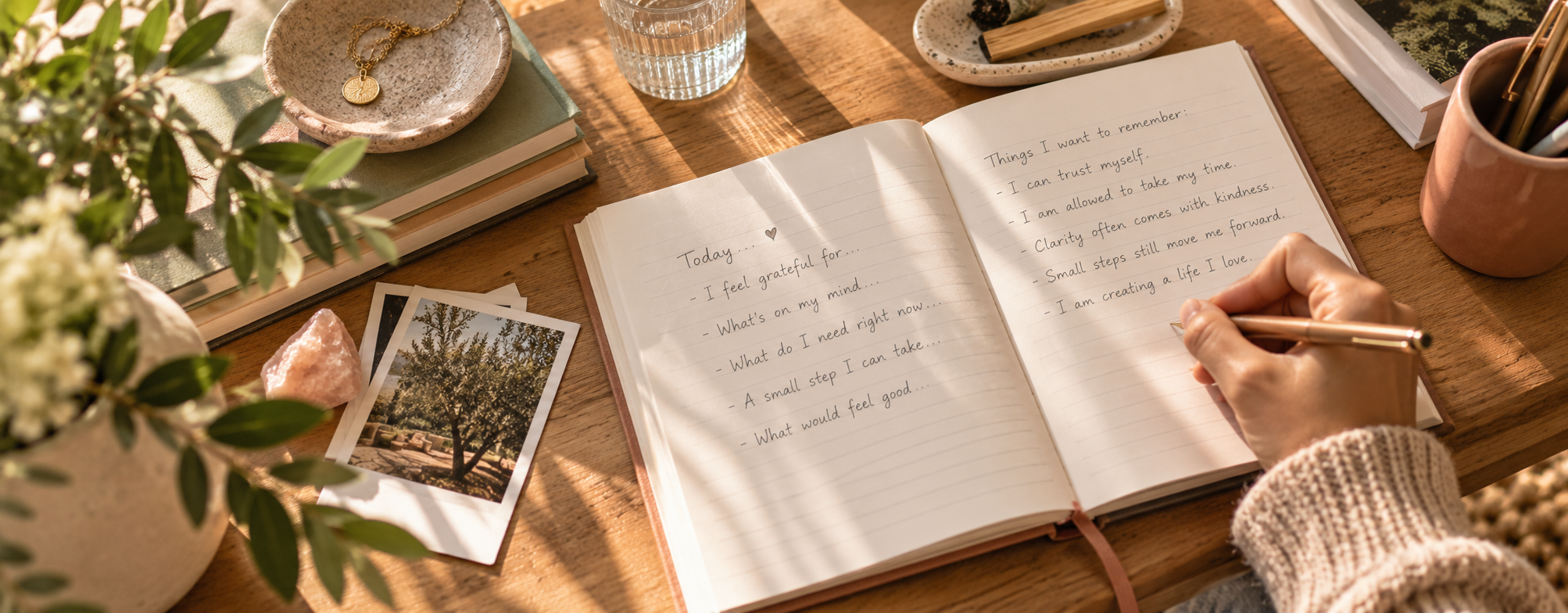
Journaling for clarity and self-trust
A page can become a place to hear what you already know — and what you are still learning.
A notebook does not ask you to be impressive. It does not interrupt, correct your feelings, or expect you to arrive with a conclusion. You can begin with a sentence as ordinary as “I don’t know what to do,” and discover, a few lines later, that you know more than you thought.
We often look for clarity by collecting other people’s opinions. We ask a friend, search for advice, replay a conversation. Their perspectives can help. But sometimes all those voices make it harder to recognize our own. Writing creates a private space where you can listen before deciding.
Write what is true, not what sounds wise
There is no prize for a beautiful journal entry. Some days your page may be full of crossed-out sentences, contradictions, or frustration. That is not a failed practice. It is an honest record of being human.
Try finishing this sentence without editing yourself: “What I wish I could say is…” You do not have to show the answer to anyone. The freedom to be unpolished is part of what makes writing useful.
Separate the facts from the story
When something unsettles you, divide a page into two columns: “What I know” and “What I am assuming.” “They haven’t answered my message” belongs in the first column. “They must be upset with me” belongs in the second. Both thoughts may feel powerful, but they are not the same kind of information.
This small distinction will not solve every uncertainty. It can, however, keep fear from quietly presenting itself as fact.
Ask questions that sound like you
Instead of asking what a perfect, confident person would do, try questions that invite a more personal answer: “What am I pretending not to know?” “When did I last trust my judgment?” “What would I choose if I were not trying to please everyone?” “What part of this decision feels like mine?”
Choose one question and stay with it for five minutes. You may find an answer, or you may find a better question. Both are forms of progress.
Let your own history become evidence
A journal also preserves details that memory tends to blur: a hard season you survived, a boundary you managed to set, a choice that felt frightening and later proved right. Looking back does not mean every past decision was wise. It means you can see the fuller story of how you learned.
Self-trust is not the belief that you will never make a mistake. It is the growing knowledge that you can pay attention, make a choice, and respond with care when life surprises you.
Keep it small enough to be yours
You do not need an expensive notebook or a daily streak. Write three lines on a Sunday, a note on your phone after a difficult conversation, or one sentence before bed. Some weeks you will write nothing. The page will still be there when you return.
Over time, the most valuable thing you collect may not be answers. It may be the experience of taking your own thoughts seriously.
Begin with one honest sentence.
If you have a few minutes today, open a blank page and write: “Something I know about myself, even when I forget it, is…” You do not need to finish with certainty. Sometimes the simple act of listening to your own voice is where trust begins.
Practice with Now